
 Katharina Frohne
From Volunteer Fish Observations to an International Research Resource
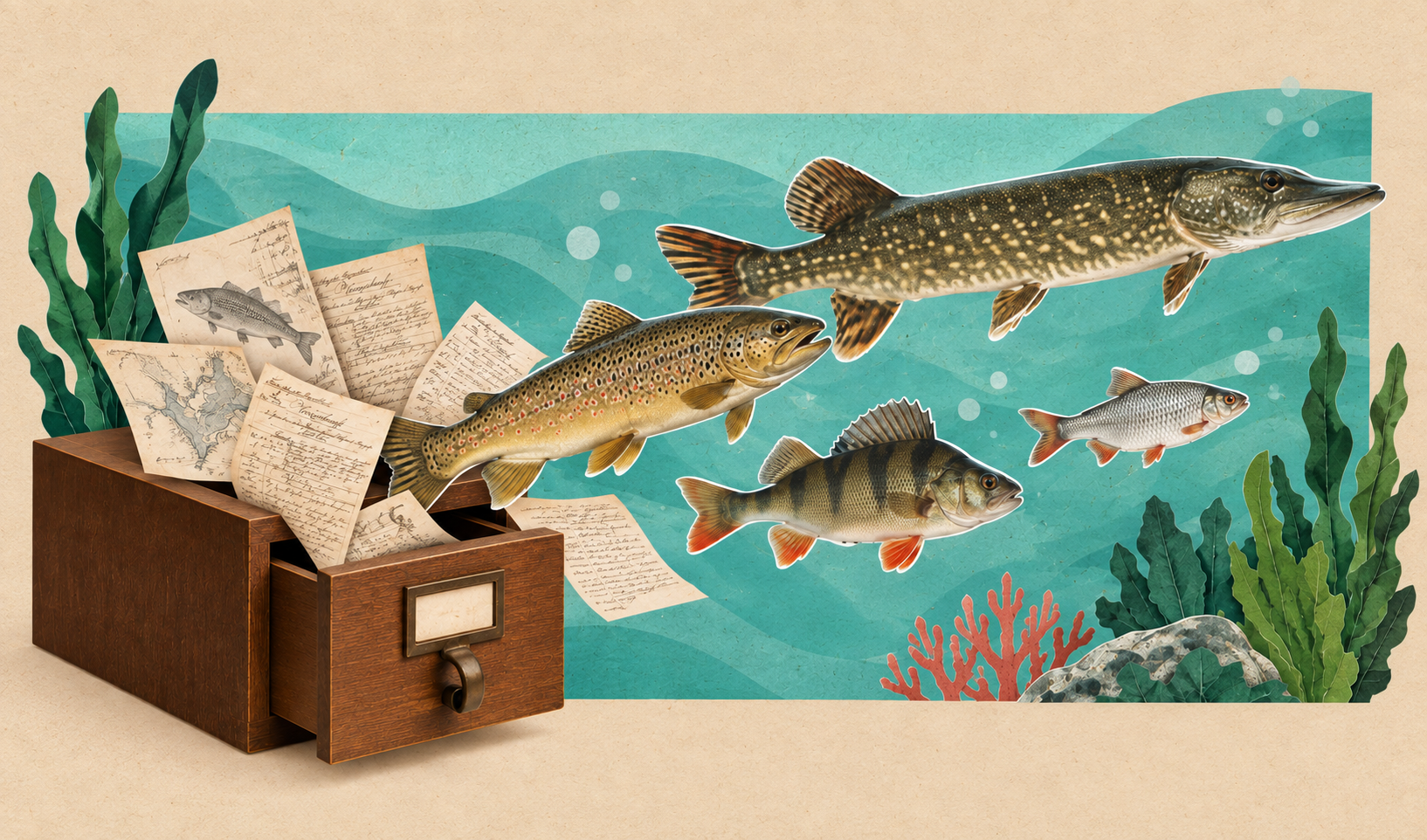
A new Data Paper in the Biodiversity Data Journal explores how data from the GfI Fish Species Atlas were made available for scientific use. The publication is the result of a collaboration that began during NFDI4Biodiversity’s first funding phase (2020–2025) and is now being continued through a Topic Table.
Anyone who wants to find out where a particular fish species occurs might assume that the answer is easy to look up. In reality, however, the information is often scattered across many different sources: scientific publications and theses, government registers, regional databases, and records kept by volunteer fish experts. The data were collected at different times, using different methods and at different spatial scales. Some locations were precisely surveyed, while others were merely assigned to an area on a topographic map.
This presents a problem for research and conservation, since reliable and internationally comparable distribution data are needed to investigate changes in populations, assess the condition of aquatic ecosystems, and provide a scientific basis for measures to protect species and habitats.
A team led by the German Ichthyological Society has now described how these many individual sources can be transformed into a robust and reusable dataset. The article “The ‘GfI-Fischartenatlas’ of the German Ichthyological Society (GfI) – A compilation of validated fish species occurrence records” was published as a Data Paper in the Biodiversity Data Journal in July 2026. Its authors are affiliated with Bremen University of Applied Sciences, Friedrich Schiller University Jena, the German Centre for Integrative Biodiversity Research (iDiv), the Leibniz Institute for the Analysis of Biodiversity Change – Museum Koenig Bonn, the German Federation for Biological Data (GFBio e.V.), and the Helmholtz Centre for Environmental Research (UFZ).
The paper sheds light on what usually remains in the background: Where do the data come from? And how exactly were they made usable?
A Data Paper differs from a conventional research article. Rather than testing a specific hypothesis, it focuses on a dataset or the infrastructure from which that dataset emerged. Among other things, it describes the data’s origin and structure, quality-control procedures, technical formats, and opportunities for reuse.
These questions are crucial. Data that are accessible are not necessarily understandable – let alone scientifically robust. Anyone wishing to use occurrence records in an analysis must be able to assess where they came from, what an individual entry means, how it was verified, and what limitations need to be considered when interpreting it.
The new publication brings together precisely this information for the GfI Fish Species Atlas. It also makes visible the often unseen work behind a biodiversity database: researching and recording sources, standardising species names, verifying submitted observations, documenting spatial inaccuracies, developing a technical infrastructure, and resolving legal questions.
This allows researchers to determine whether the data are suitable for a particular research question. For operators of comparable databases, meanwhile, the publication provides a practical example of how a heterogeneous dataset accumulated over many years can be systematically made accessible.
An Atlas, Many Sources of Knowledge
Since 2003, the German Ichthyological Society and Bremen University of Applied Sciences have operated the GfI Fish Species Atlas. It brings together information on the distribution of freshwater and marine fish, connecting science, practice, and environmental education. Its technical foundation was developed through a collaboration between the biology and computer-science departments at Bremen University of Applied Sciences. The data are hosted by the biodiversity informatics team at Museum Koenig Bonn, which is part of the Leibniz Institute for the Analysis of Biodiversity Change.
The atlas contains both information collected specifically for the project and data integrated from other sources. As of 13 March 2026, it contained a total of 136,714 records. The dataset described in detail in the Data Paper and made available through the Global Biodiversity Information Facility (GBIF) comprises 62,545 occurrence records for 264 freshwater and marine fish species from 16 European countries, with a particular focus on Germany and Austria.
The records come from scientific literature as well as so-called grey literature – reports, expert assessments, and theses that have not been published through conventional academic publishers. They also include observations contributed through citizen-science projects.
The team deliberately did not eliminate the differences in how the data were produced. Instead, it made them transparent and machine-readable. Only then can future users decide which records are suitable for their research – and which are not.
Each entry documents the occurrence of a species at a particular place and time, or within a specified period. The sources, however, differ considerably in their precision and provenance. A published source may provide exact coordinates or refer only to a topographic map sheet. The atlas also includes personal communications and directly submitted observations.
The team did not have to eliminate these differences – but it did have to make them visible, transparent, and machine-readable. Only then can future users determine which records are suitable for their research – and which are not.
Quality Depends on Transparent Rules
The scientific value of the atlas therefore lies not only in the number of its records, but also in the way they are verified and documented.
The publication explains how individual observations are extracted from a source and subsequently converted into species-specific occurrence records. Information from literature and databases remains linked to its original source, as do personal communications and directly submitted records. The species names used are checked against an established taxonomic reference. This makes it possible to determine which species is meant when a source uses an older or regionally differing name.
The limitations of the data are also clearly stated. The atlas documents where a species occurs, but it does not systematically record where a species is absent. A lack of records for a particular area therefore does not automatically mean that the species concerned does not occur there. For scientific analyses, this information can be just as important as the recorded locations themselves.
The publication thus provides transparency about decisions that are barely visible on a finished distribution map. It demonstrates that data quality in a community-based project does not arise from complete uniformity, but from expert verification, documented provenance, and clearly identified uncertainties.
Launched as an NFDI4Biodiversity Use Case Project
Work to make the data more widely reusable began during NFDI4Biodiversity’s first funding phase. Through the Use Cases – an exploratory format used during this phase – partners from the biodiversity community worked with the consortium’s subject-matter and technical experts to address specific challenges.
For the Fish Species Atlas, the aim was to make data and tools more accessible to researchers, public authorities, and environmental educators. Another objective was to connect the dataset to cross-cutting research-data infrastructures.
The team first examined whether the necessary metadata were available and how they could be converted into an established biodiversity-data standard. A BioCASE provider was set up together with Museum Koenig Bonn. This standardised interface makes it possible to provide the observation data in ABCD format and connect them both to the NFDI4Biodiversity network and to international infrastructures such as GBIF.
Such technical work generally remains invisible to users. Yet it determines whether data can only be viewed on a single website or can also be retrieved automatically, combined with other datasets, and used in cross-cutting analyses.
The project therefore addresses one of NFDI4Biodiversity’s core tasks: valuable data that have previously been organised in decentralised structures should not simply be available online, but should also be findable, accessible, interoperable, and reusable in accordance with the FAIR Principles. At the same time, the Use Case shows that there is no one-size-fits-all solution. The infrastructure must be adapted to the specific characteristics of the data, their sources, and the community involved.
Open Data Require Legal Clarity
Yet technical questions were not the only issue. The atlas has grown over many years, and numerous records were contributed by volunteers or taken from existing sources. Before the data could be published internationally, several questions therefore had to be resolved: Who has the right to make the data available? Which information is protected by copyright or database rights? And under what conditions may the names of contributors be published?
NFDI4Biodiversity commissioned a legal assessment on the publication and reuse of species-occurrence data. Using the GfI Fish Species Atlas as a case study, it examined copyright, database rights, data protection, research ethics, and licensing. Its conclusion was that, in principle, nothing prevents the data from being integrated into GBIF – provided that certain requirements are met. These include, in particular, obtaining the consent of volunteer contributors and establishing appropriate terms of use and data-protection provisions.
The legal assessment was prepared by Tom Grünberger of the Independent Institute for Environmental Issues (UfU). As a practice partner, the GfI contributed the dataset and the specific questions to be examined, while GFBio e.V. funded the assessment. The Fish Species Atlas data were subsequently published in accordance with the recommendations of the legal guidelines.
This aspect of the project’s development is also relevant beyond the atlas itself: Citizen-science data should be made as openly available as possible. At the same time, the rights and interests of the people who collected them must be protected. The legal assessment and the new publication demonstrate that openness and legal certainty are not mutually exclusive – but they must be considered together, ideally from the outset.
The Collaboration Continues – as an NFDI4Biodiversity Topic Table
The collaboration is currently continuing through the NFDI4Biodiversity Topic Table Integration of Citizen Science Data for Monitoring Aquatic Habitats. It brings together citizen-science projects, researchers, scientific societies, public authorities, and conservation organisations to develop approaches for archiving, curating, harmonising, and publishing aquatic observation data in accordance with the FAIR Principles.
At the heart of this work lies a fundamental challenge in biodiversity monitoring: Data collected by volunteers can help close spatial and temporal gaps in scientific and governmental surveys. In practice, however, this considerable potential has so far been only partially realised because datasets – as in the case of the Fish Species Atlas – are maintained according to different rules and cannot always be readily linked. The Topic Table therefore examines both the potential and the limitations of integrating such datasets.
Legal Opinion Provides Guidance for Similar Collections
For ichthyologists, the Data Paper offers a detailed description of an extensive source of distribution data. Its scientific value, however, is not limited to ichthyology. Many scientific societies, museums, public authorities, associations, and citizen-science initiatives hold datasets that have grown over decades. These contain valuable knowledge, but they cannot necessarily be incorporated directly into modern research-data infrastructures: Sources are documented with varying degrees of precision, terminology has evolved, technical systems have developed over time, and legal responsibilities are not always clearly defined.
The new publication therefore documents more than a result. It documents a process: from a scientific society’s online portal through technical standardisation and legal review to international dissemination and scientific description. In doing so, it offers valuable guidance that extends well beyond the specific example of the Fish Species Atlas.



News
From Volunteer Fish Observations to an Internation...

A Long-Term Future for NFDI: Transition to Permane...
BIIGLE4Beginners: A New Online Tutorial for Image ...
Open Data, Shared Responsibility: New Guidance Sho...

Historical Biodiversity Dataset Receives FAIRest D...

CloWM Joins the NFDI4Biodiversity Service Catalog ...
From Three to Six: Biodata Interest Group Publishe...

"Creating knowledge without data is impossible"

NFDI4Biodiversity Flexfunds: Three Projects Show H...